
qusra.
both fragile and immovable.

------------------------------------------------------------
i came from the bus station not really knowing what i was doing or where exactly i was supposed to go. i had messaged my contact but i had to switch sim cards several times and my service wasn’t great, so that made communication feel a little uncertain at a time when it was obviously crucial. and knowing a name on a screen and knowing a person in real life are two completely different things.
i stood outside the station with my bag hooked tight in my fist, looking around like i was studying the architecture, like i was just another traveler pausing to take it all in, trying not to look lost even though i felt lost and not lost at the same time. because i had definitively made it to palestine. that part was done. the crossing, the checkpoints. i had made it thru all that. my feet were on the pavement. the sky was the same blue it is everywhere and not the same at all. i definitely got a lot of stares. the tattoos, piercings, the punk-militant attire. its obvious i’m not from there. the the israelis stare with a suspicious vibe. one that screams “we’ve been doing really bad shit to people and we hope u don’t know we’re guilty as fuck”. palestinians stared with a friendly vibe that to me felt like “i see u, my nigga. welcome.”
first time out of the country. first time stepping into something i had only understood thru books, articles, footage, and stories. i had memorized maps, learned dates, and watched clips until they felt like memories.
but now it was real, u know?
i wasnt lost exactly. i was suspended. between the version of palestine i had carried in my head and the one unfolding in front of me. between theory and touch. between distance and dust. and standing there with my bag, with my heart beating too loud for a morning that seemed otherwise ordinary, i realized the crossing had not just been at the border. it was happening inside me too.
-----------------------------------------
people passed me sometimes without noticing i was trying very hard to look like i belonged. i practiced a neutral face. not too curious, not too lost. i adjusted my shoulders, let my arms swing the way i had seen confident people do. there is a particular stiffness to pretending. u become hyperaware of your hands. of where to look. of how long to hold a glance before it turns into staring.
i told myself: u wanted to be here. u chose this. u said u were ready. i repeated it like a line i had memorized for an audition. u wanted this. u chose this. u are ready. the words were clean and declarative. they sounded strong in theory. but inside, something trembled. there was that flicker in my chest, half fear, half awe, like stepping onto a stage without fully knowing your lines, like feeling the heat of the lights before u have decided what kind of voice u will use. awe because this was the thing i had asked for. fear because now it was real and real things require proof.
imposter syndrome didn’t arrive nicely at all. it surged. it was a sudden certainty that everyone else had been handed a manual and i had missed the distribution. that there were codes being spoken in casual tones, references exchanged like currency, and i was standing there with empty pockets, nodding along. it told me that any moment someone would stop mid sentence, squint at me, and say wait. who let u tf in.
and yet beneath all that was something stubborn. a small, steady insistence. u wanted to be here. u chose this. u said u were ready. the flicker in my chest was not only fear. it was also fearlessness. the stage felt terrifying because it mattered. the script felt uncertain because i was still writing it. the rhythm was uneven because i was still learning how to move with it.
--------------------------------------------------------
my contact’s comrade showed up in a van to pick me up. i did not know him. i had never seen his face before. and that right there kind of sums up a lot of the trip. i did not know people. i was constantly meeting strangers who were not strangers to the struggle, but were strangers to me. and i just had to go with it. go with the flow. trust. because what else was i going to do. interrogate every situation. freeze up. turn back. no. i had come too far for that.
i put my faith in allah. straight up. i believe allah protects me. i believe allah knows my intentions. so i don’t move in the world paralyzed. cautious, yes. aware and alot of times even hypervigilant. but not paralyzed. so when he pulled up in that van and motioned for me to get in, i got in. my dumb ass went straight to the back seat, because i wasn’t sure if this was like a taxi situation or what. he laughed and was like hey, hey, come sit up front. so i moved up front next to him. and just like that, we slid.
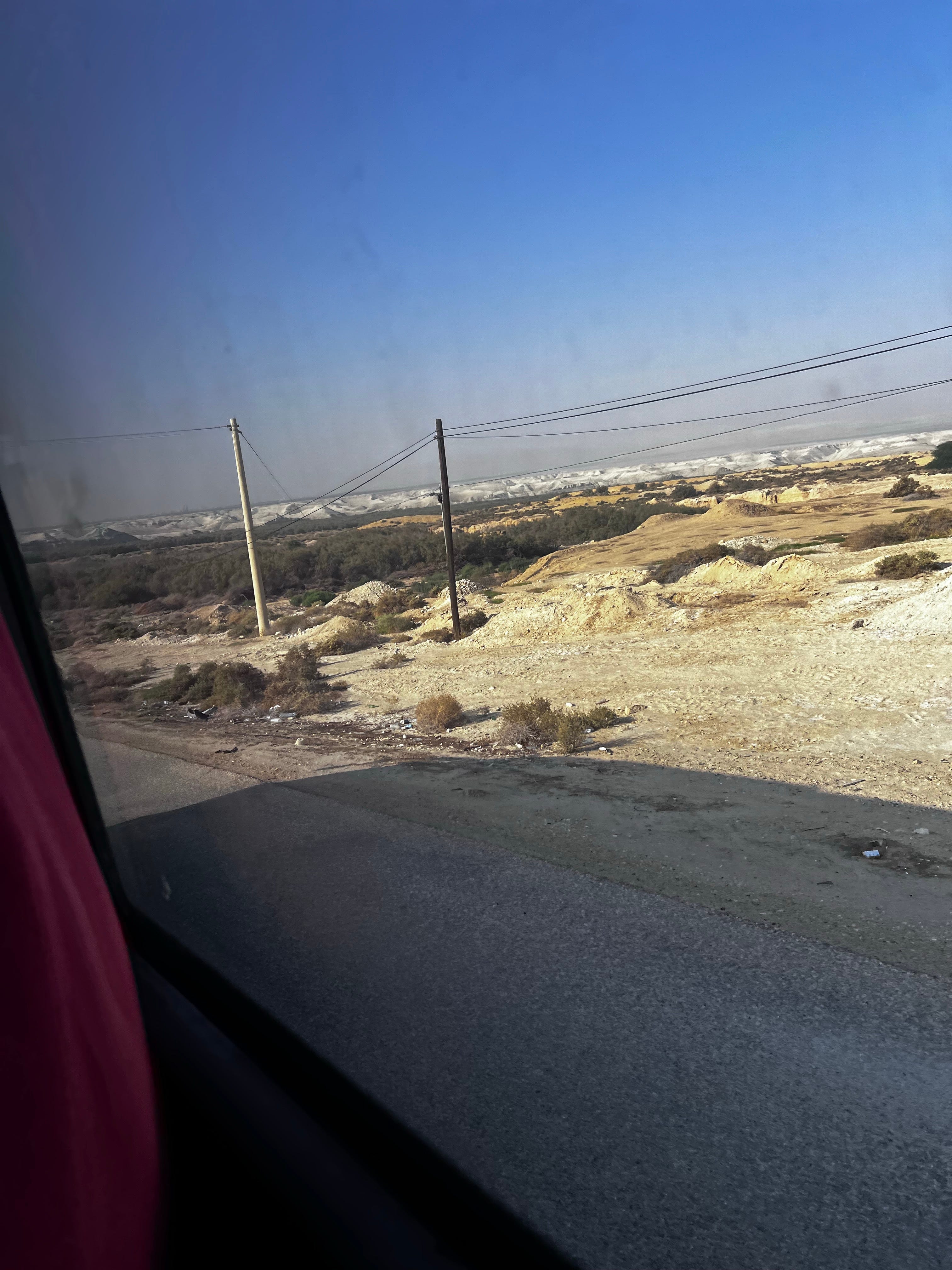
we pulled out of the terminal after short but friendly intros and he started driving fast. and i mean fast. this old van, engine humming like it had stories of its own, and he is smashing down the road like we're in a race. curves, hills, traffic, no hesitation. and i remember thinking not even about fear but about familiarity. because i have been sixteen years old in a car going way too fast. i have been in the back seat passing a blunt around while somebody pushes one hundred ten miles an hour listening to brotha lynch hung. so the speed itself wasnt what shook me. it was the totality of it. the context. the fact that i am in occupied palestine, in a van with a dude i just met, flying down a road lined with those freaky-ass zio flags. so yeah im actually sure it was the zio flags that kept giving me the ick. u know, the ick? like when u see something that looks hella nasty and disgusting and makes u wanna vomit. bubbleguts.
as we drove he started pointing things out. slow at first, like somebody tracing scars on their own body. this land, he said, used to belong to palestinians. that ridge there. that valley over there. the hill with the neat rows of pale houses sitting on top like teeth. this land here. this land there.
but of course, the occupation.
they take.
they take.
they take.
he said it like that. not loud. not angry even. just steady. like something that no longer requires emphasis because the evidence is everywhere u look. they take.
and he talks about the roads. some roads settlers use freely, smooth and wide, moving clean through the landscape. and other roads palestinians can’t use at all. or can only use sometimes. or must pass checkpoints to cross.
he says amerikkka too. not america. amerikkka.
about how amerikkka supports this. funds this. protects this politically. how the weapons, the money, the diplomatic shields. how all that flows from across an ocean and lands right here on these hills.
and i’m sitting there nodding like hell yeah. yeah. i hear u. i feel u.
because none of it is new information to me. none of it is surprising. empire isn’t subtle and settler colonialism isn’t exactly hiding. but hearing it while we’re physically passing the hills he’s talking about… damn bro. fuck these settlers. knowledge shifts when the ground underneath it is literal.
and i could feel he was trying to impress something upon me. not in a dramatic way and not like a lecture. it just felt hella urgent. like he wanted to make sure the landscape spoke clearly before we passed it. like he was thinking, just in case.
just in case u leave here and people start telling u other stories.
just in case the maps erase things again.
i feel u big bruh.
--------------------------------
i want to move through this part carefully, slowly, and with the respect it deserves. this part is not about speaking for anyone or claiming authority over a story that isn’t mine. its about trying to place what i witnessed into a broader context and to learn more about the history that shapes the present there.
places like this hold layers of history that are not immediately visible to someone passing thru. the everyday life of a village can carry generations of memory, struggle, and resilience beneath the surface. taking time to read, listen, and reflect felt like the smallest way of approaching that reality with care. what follows is simply an attempt to share a bit of what i learned and to acknowledge the people whose lives and losses give the place its meaning.
----------------------------------------------------------
“People are trapped in history and history is trapped in them.”
-James Baldwin, from his 1955 essay “Stranger in the Village” in Notes of a Native Son
qusra is a village in the hills southeast of nablus. it’s small enough that most maps pass over it, old enough that its story reaches back centuries. the place appears in ottoman tax registers in 1596 under the name qusayra, fourteen Muslim households paying taxes on wheat, barley, olives, goats, and beehives. which is to say it began the way many villages in those hills began, with land and labor, with families working stone terraces and olive groves that had already been there for hella long. travelers passing thru in the nineteenth century described it as a modest farming village surrounded by olive trees and rock cut cisterns catching winter rain. by 1870 perhaps two hundred people lived there. by the early twentieth century the community had settled into the rhythm of rural life in the nablus highlands. under the british mandate the population grew slowly. seven hundred residents in 1922, eight hundred fifty one by 1931. by 1945 there were about eleven hundred people and much of the land was planted with olives and cereals that tied families directly to the hills they had worked for generations. after the war of 1948 the village fell under jordanian rule. by 1961 the population had reached about thirteen hundred. then came 1967 and the Six Day War, and the land entered the long unsettled condition of Israeli military occupation that still shapes everyday life across the west bank.
in recent decades the agricultural character of qusra has been complicated by the political geography surrounding it. the village sits near several settlements and outposts, including the settlement of migdalim established in the 1980s on land taken from nearby villages. after the oslo accords the landscape was divided into administrative zones known as area B and area C, leaving roughly half the village land under direct israeli control and the other half under a mixed system of palestinian civil administration and israeli security authority. on paper those categories appear technical. on the ground they translate into roads that can close without warning, farmland that sometimes requires coordination to access, and hillsides where farmers, settlers, and soldiers encounter one another with tense regularity. villages in this belt of hills including qusra, duma, and qaryut have for years existed inside that friction. confrontations around farmland, attacks on property, clashes during the olive harvest when families return to groves their grandparents planted. yet even inside that tension the village has continued to grow. more than five thousand people live there now. children walk the same paths between houses and fields, olive trees still anchor the local economy, and life moves forward in the shadow of politics that rarely feels distant.
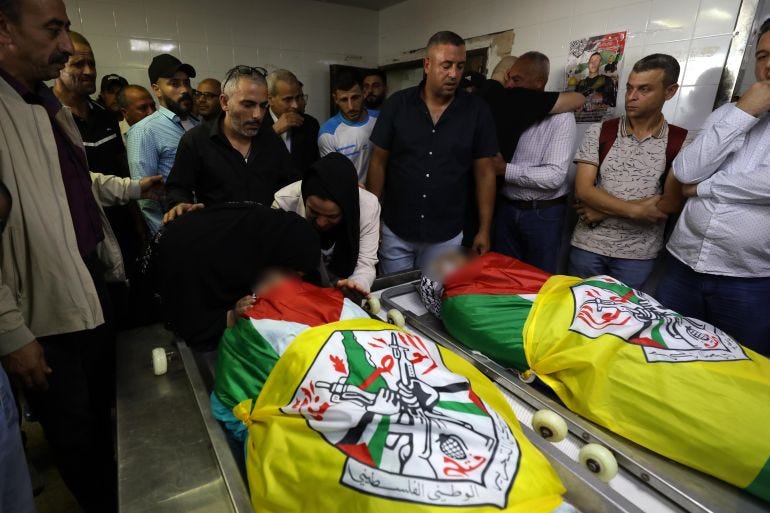
that tension broke open in october 2023. the funeral attack in qusra that month came after a chain of killings that unfolded across roughly twenty four hours, which is why people there speak about those days like a single wound rather than separate incidents. on 11 october armed settlers moved toward the village and confrontations broke out with residents. gunfire followed. by the end of the evening four men from the village were dead. Moaz Odeh. Musab Abu Rida. Hassan Odeh. Abada Odeh. several others were wounded. the killings happened in the charged atmosphere spreading across the west bank after the genocide in gaza erupted following the october 7 attacks, a moment when both military raids and settler violence surged throughout the territory. the next day hundreds of villagers gathered to bury the four men. the funeral convoy left the hospital carrying the bodies, ambulances and cars filled with mourners moving slowly back toward the village. near the town of al sawiya settlers blocked the road. witnesses said vehicles were stopped, objects thrown, and then gunfire began. israeli forces were present in the area and said they were responding to clashes. in that confrontation two more men from qusra were shot by the occupation. a father and his son. Ibrahim Ahmed Mahmoud al Wadi, a farmer in his early sixties whose family had worked the surrounding land for generations. and Ahmed al Wadi, in his mid twenties, recently graduated from university and planning to become a lawyer. relatives later said they were trying to drive through the blocked road while mourners attempted to clear a path for the funeral procession. both men were critically wounded and died soon after.
in the span of about a day the village lost six people. Moaz Odeh. Musab Abu Rida. Hassan Odeh. Abada Odeh. Ibrahim al Wadi. Ahmed al Wadi. funerals in the West Bank gather entire communities. hundreds walking together thru narrow roads, grief moving thru the village like a tide. in places like qusra those gatherings happen in landscapes already crowded with armed actors, settlers on nearby hills, soldiers controlling roads, patrols moving thru farmland. grief becomes a public moment. the public moment collides with the gears of conflict. in qusra that cycle happened almost immediately. one night of killings produced the funeral, and the funeral produced two more deaths the next day. those days became one of the reminders of how the broader conflict manifests itself at the level of ordinary villages. not as distant geopolitics, not as speeches or negotiations, but on a road between a hospital and a cemetery where a community trying to bury its dead suddenly finds itself under fire again. remembering the names of those six individuals is a small act of respect. a way of acknowledging that behind the reports and statistics there remains a village on a hillside, carrying its history forward and burying its own with dignity. names written in the sky.
what lingers after the names is the deeper question the moment raises about power and the conditions it creates. abolitionist thought insists that violence like this is rarely accidental. it grows out of structures that normalize surveillance, armed authority, and unequal control over land and movement. in places like qusra the geography itself has been reorganized around those forces. roads, hilltops, patrols, settlements, all shaping how people move, work, and gather. when a funeral procession becomes dangerous it reveals how far that logic has reached. even mourning, one of the most basic human rituals, is forced to pass thru a landscape structured by domination.
from a distance the temptation is to treat the type of events like they are isolated tragedies, moments of grief that appear and disappear within the wider conflict. but what stays with u is the persistence of the people who continue living there. planting trees, tending land, finishing school, walking together behind the dead even when the road ahead is uncertain. and existentially that persistence carries its own meaning.
yeah, we see its war outside, but we are hard to kill.
because we are full of life.
.
Al Jazeera. “Palestinian Man, Son Attending Funeral Procession in West Bank Shot Dead.” October 12, 2023.
The Independent. “Father and Son Killed During Funeral Procession in West Bank Violence.” October 15, 2023.
Middle East Monitor. “Israeli Settlers Kill Father and Son in Nablus During Funeral Procession.” October 13, 2023
wikipedia
---------------------------------------------------------------------------------
qusra is really just instant beauty. that is the only way i can say it. the land looked fertile. and i know i dont really know shit about agriculture. i couldnt break down soil composition for u. but u know when something looks alive. a kind of green that feels stubborn. like it refuses to disappear. that is what it looked like. stubborn life.
and getting there made something else clear. the occupation doesn’t just control land in a broad sense. it controls movement. it controls the way people move thru space. i saw over and over again how towns are boxed in, and i’ll probably talk about that often. shit was just crazy. roads blocked. entrances sealed. sometimes there’s only one way in and one way out. and that one road might not be paved. might be narrow and winding and vulnerable. that is not accidental. that is strategy. control space and u control time. u make it harder to get to work. harder to get to school. harder to get to the hospital. u stretch out daily life into a fucking obstacle course. it’s spatial domination and temporal domination at the same time.
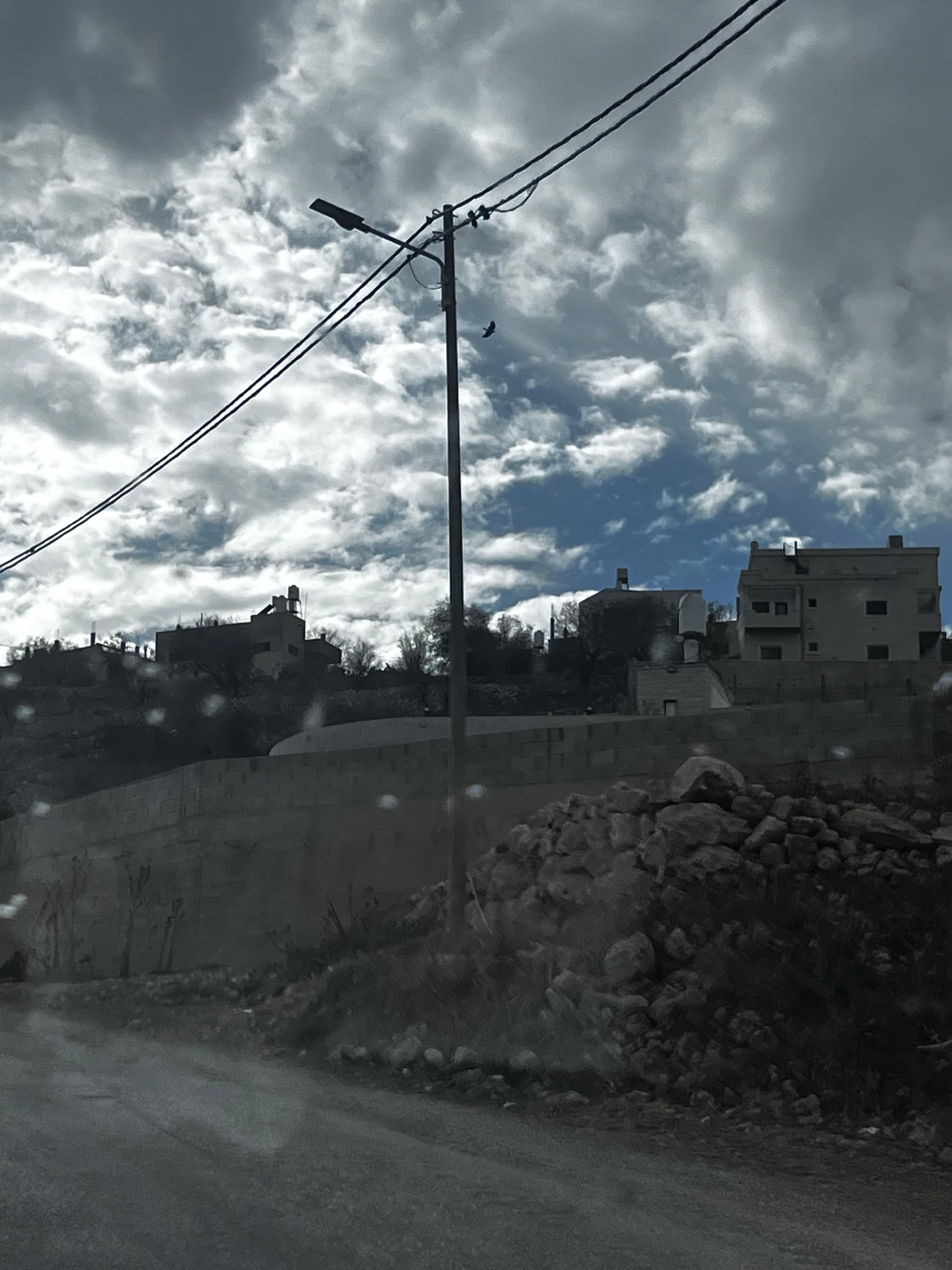
so by the time we rolled into the town, i was already processing a thousand things. and then i stepped out of the van and into the town itself. and it felt old. and the people, too. u look at palestinians in qusra and u feel that rootedness. like they aren’t visiting. like they didnt arrive recently. like they are of that soil.
my host there was gracious in a way that is hard to put into words. there is hospitality and then there is hospitality that feels like principle. like dignity. he welcomed me not as a tourist, not as some outsider to be impressed, but as someone who was stepping into shared struggle. he told me this is your home while u are here. we ate together. we drank tea. we sat and talked.
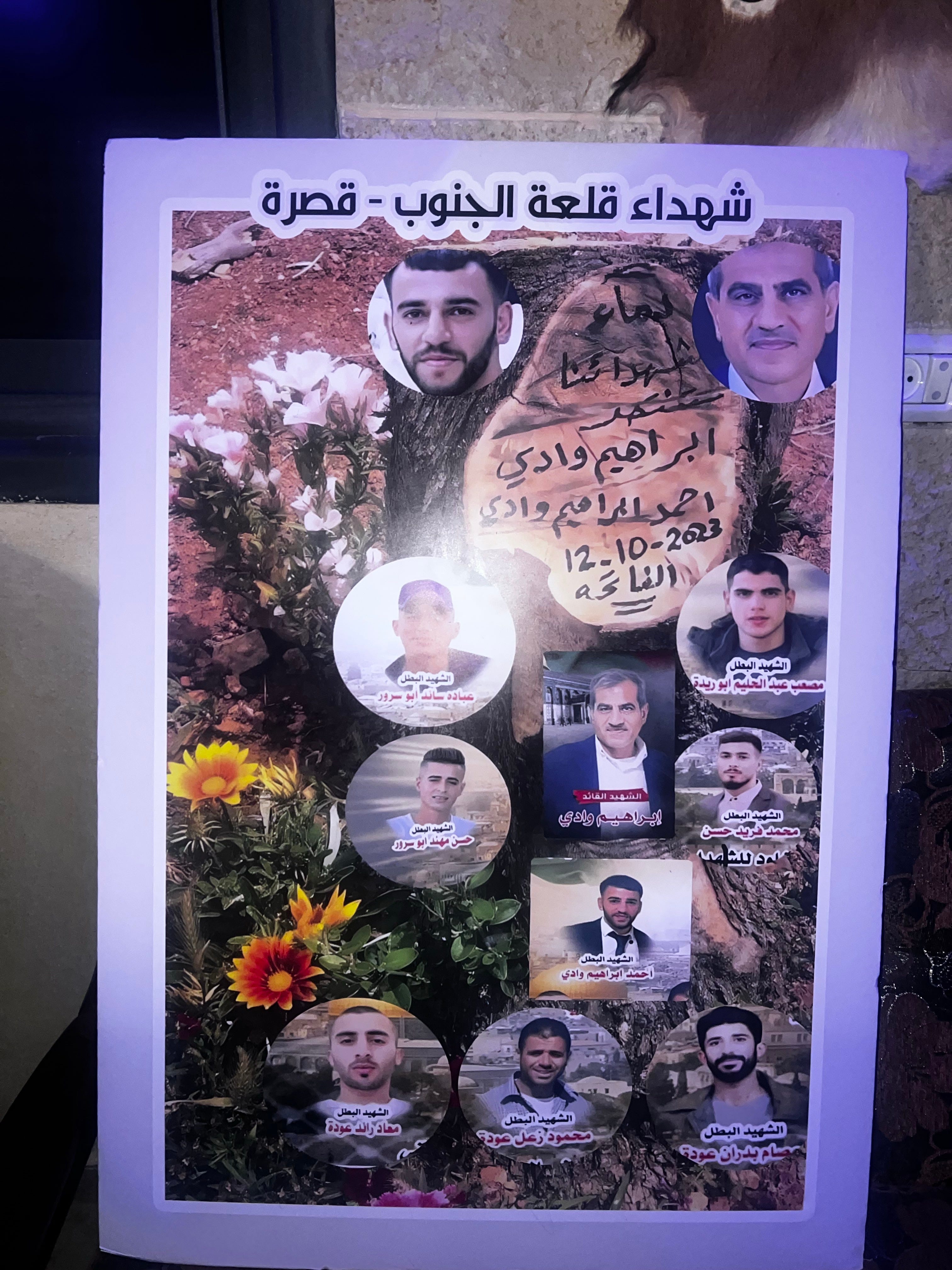
and as i mentioned in my previous post, there is a harsh duality to it. warmth and weight. because in his home were photos. photos of family members killed by the occupation. martyred. and aint no way u can sit in a room with those faces on the wall and remain abstract about politics. u can’t reduce it to statistics. these are people. brothers. sons. cousins. stories attached to each frame.
he had experienced loss directly. and yet he carried himself with steadiness. sumud. with wisdom about resistance that didn’t feel loud but felt deep. aint nobody performing resistance around here, it felt alot more like a daily commitment for my host. tending land. staying. raising children. remembering the names of the dead.
---------------------------------------------------------------
there is a moment when reality sinks in differently. when u realize the fragility of life not in some philosophical way but in a tangible way. when u understand that your own life could be oriented differently. that there is more u could do. more u could risk. rearrange yourself.
over and over, my host expressed appreciation that i had come. and i kept thinking about how small my presence felt compared to what they endure daily. and yet he insisted it mattered. that solidarity matters. that witness matters. that connection matters. and as an ex-slave, that reciprocity is real. it was seeing and being seen.
-----------------------------------------------------------
the first time i heard the adan in qusra, i was half-asleep. it was that kind of sleep where your body knows u not home, it knows u are somewhere unfamiliar, so every sound makes u say, “hold up. wtf was that noise outside?”
the room was still dark. and i remember hearing everything. every vehicle way off in the distance. birds making bird sounds or maybe not bird sounds. random sounds with no names. silence stretching between them.
and somewhere in that quiet my mind started doing what it knows how to do best, which is running ahead of the moment. catastrophizing. my imagination getting real militant, unprovoked tho. what if the occupation pulls up in the middle of the night. what if they come thru banging on the door. what if headlights slide across the wall and boots hit the dirt outside. what if. and i had to catch myself. consciously stop the spiral. breathe. remind my body where it actually was.
but that vigiilant feeling, it settled in quick. not even like it arrived. more like it recognized home.
i know that feeling from prison. laying in the dark of a cell, eyes open before the tier wakes up. peering thru the crack in the door window. looking down that long stretch of steel and concrete. listening. always listening. waiting for the sound of keys jangling at the waist of some bored correctional officer who decided tonight was the night to violently search your cell, flip your mattress, scatter your letters, remind u that u are not human. them keys got a sound u never forget.
and then later, out here. technically “free,” but on parole. which ain’t freedom so much as a leash with paperwork attached. sleeping light. ears tuned to every engine that slows outside the house. every footstep on the sidewalk. every knock that comes too hard. wondering if police about to kick the door in. wondering if somebody decided today is the day they take u back to that cell, away from everything u love.
so the body learns!! but anyways.
i’d sit up sharp. stiff. still. silent. breathing slow like the air itself might betray me. a nigga learns stealth for real, like a cat or something. survival got a curriculum. muscle memory and instinct. listening before moving. feeling the room before standing up.
because one thing i know fasho fasho, i ain’t letting 12 sneak up on me.
and not the occupation either.
and then it came!
allahu akbar… allahu akbar…
words just floating right into my ears, leaning into me, hella clear. the melodic cadence stretched across the hills. it wasn’t just a sound that came inside the room. it was outside, moving thru the town, bouncing off houses, slipping between olive trees, settling into the valleys. u could hear how the land held it. like the hills themselves were repeating it back as if a call and response.
i remember sitting up slowly, still wrapped in the blanket, just listening. i was kinda frozen for a bit. i should have made salat but in that moment, the prayer was such a gift to my ears that i just wanted to relish in. in that moment it didnt feel like a single voice. it felt like the entire place breathing. the whole town waking up in remembrance at the same time. and this was qusra. a town under occupation. hills marked by confiscated land, with roads that could be closed at any moment. soldiers not that far away. and still, before the day begins, before the empire cranks its rusty engine, the first sound cutting thru the quiet is a reminder that god is greater!
allahu akbar..
greater than checkpoints. greater than soldiers. greater than fences and settlements and all the small arrogant structures men build when they think they control the world. just knock it off, ok guys?
and the voice is also an invitation. hayya ala salah. come to prayer. hayya ala al-falah. come to success. and i remember thinking how strange the word success sounds at that hour, in that place. success not in the way the world talks about it. not money and not power. success meaning alignment. meaning waking up before the sun to put your forehead on the ground and recognize the scale of things.
i remember feeling very small in a good way. because the day had not even started yet and already there was perspective. already there was a reminder that this world, with all its violence and its noise and its borders, is still held inside something much larger.
when the call ended there was a moment of silence again. but it was not the same silence as before. it felt charged. like the town had been stirred awake, spiritually if not physically.
somewhere a door creaked open. somewhere footsteps moved across a courtyard.
---------------------------------------------------------------------
i left qusra changed. not in some romanticized way. not as if i suddenly understood everything. but changed in seriousness. in awareness of what it means to root yourself somewhere and defend it not only with slogans but with presence and with risk.
there is something powerful about navigating with limited words and still arriving at clarity.
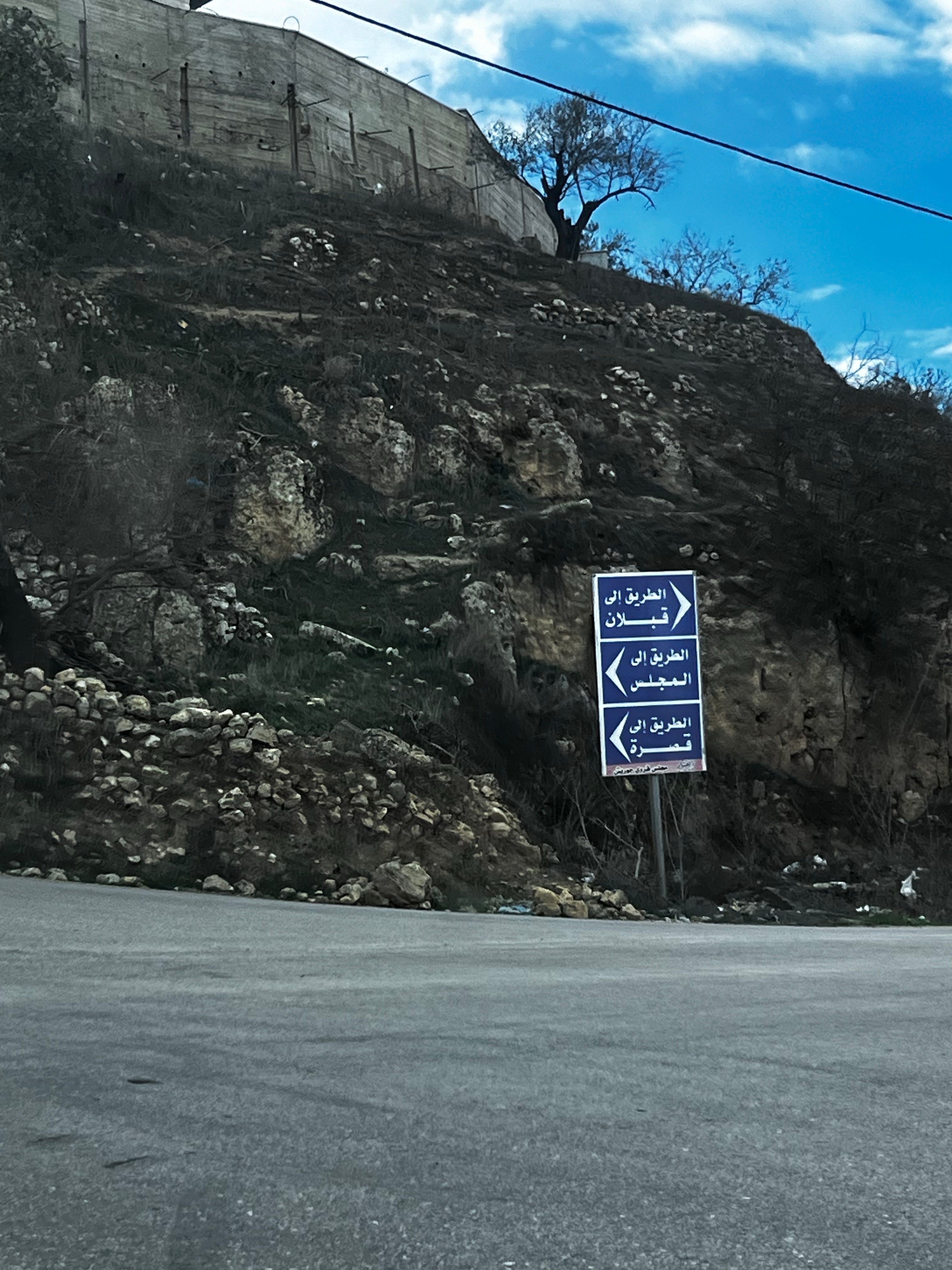
qusra was my introduction. and first impressions matter. my first impression of palestine was speed and cigarettes and stolen land pointed out through a windshield. it was an old van racing down a road that has seen too much history. it was a home filled with warmth and framed photographs of martyrs. it was fertile hills and blocked entrances. it was hospitality offered without hesitation.
when people ask me what it felt like, i struggle to condense it. because how do u explain the feeling of stepping into a place that feels both fragile and immovable?
.
.
.
.
When the hurricane swirled and spread its deluge
of dark evil
onto the good green land
‘They’ gloated. The western skies
reverberated with joyous accounts:
“The Tree has fallen!
The great trunk is smashed! The hurricane
leaves no life in the Tree!”
Had the Tree really fallen?
Never! Not with our red streams flowing forever,
not while the wine of our torn limbs
feed the thirsty roots,
Arab roots alive
tunneling deep, deep, into the land!
When the Tree rises up, the branches
shall flourish green and fresh in the sun
the laughter of the Tree shall leaf
beneath the sun
and birds shall return
Undoubtedly, the birds shall return.
The birds shall return.
“The Deluge and the Tree”
Fadwa Tugan
LL QUSRA
death to CDCR and the occupation
GLORY to the MARTYRS
Thank you. I am going to share this with my students. We’ve just been tracing Huey’s functional definition of politics and the description of the occupation of land here really helps put into context his explanation of self determination. 🙏🏼
this is amazing. i have been patiently waiting for it and your words did not disappoint. they never do. thank you.